Streamline Moderne: curves, speed lines and the ocean-liner look


Streamline Moderne is the 1930s look that made buildings, radios and rooms seem to move. Long horizontal lines, rounded corners, chrome rails and porthole windows all borrow from the fastest things of the age: ocean liners, aeroplanes and record-breaking trains. In Britain you find it on seafront pavilions, railway hotels and the Odeon cinemas that opened in towns across the country. This guide covers the style’s history, colours and shapes, four real buildings, and how to use it at home.
What is Streamline Moderne?
Streamline Moderne is the late, simplified form of Art Deco, built from smooth curves, horizontal bands and very little ornament, as if a room or building had been shaped by the wind. Designing Buildings describes it growing out of Art Deco in the 1930s, swapping zigzags and tall vertical lines for low, horizontal, mostly white forms with rounded corners, flat roofs, wraparound and porthole windows, glass block and steel balustrades. Our guide What is Art Deco? covers the earlier, more decorative chapter.
The name comes from streamlining, the shaping of a car, train or aircraft to slip through the air. In America, industrial designers such as Norman Bel Geddes, Raymond Loewy, Henry Dreyfuss and Walter Dorwin Teague applied the idea to everyday goods. Bel Geddes published his book Horizons in 1932, and his Futurama for General Motors was the most popular attraction of the 1939 New York World’s Fair. Streamlined toasters, radios and vacuum cleaners promised speed and a better future during the Depression, in chrome, aluminium and Bakelite. Our guide to American 1930s interiors follows that story indoors.
Britain took the style to the seaside and the high street. Bexhill’s De La Warr Pavilion, designed by Erich Mendelsohn and Serge Chermayeff and opened by the Duke and Duchess of York in December 1935, was one of the first big welded steel-framed buildings in Britain. The Midland Hotel at Morecambe, by Oliver Hill for the London, Midland and Scottish Railway, was built in 1932 to 1933. At Eltham Palace, Stephen and Virginia Courtauld, who took the lease in 1933, mixed historical rooms with moderne ones, wired for electric fires, synchronous clocks and a loudspeaker system; our 1930s interiors guide walks through it. Oscar Deutsch, who founded the Odeon chain in 1930, wanted a recognisable corporate image; by 1936 the circuit had 142 cinemas, most in a distinctive Moderne style. Speed itself became British: on 3 July 1938 Sir Nigel Gresley’s streamlined locomotive Mallard, with its wind-tunnel-tested casing, reached 126 mph. It is now at the National Railway Museum in York. For the wider picture of the decade, read our British 1930s interiors guide.
The Streamline Moderne palette
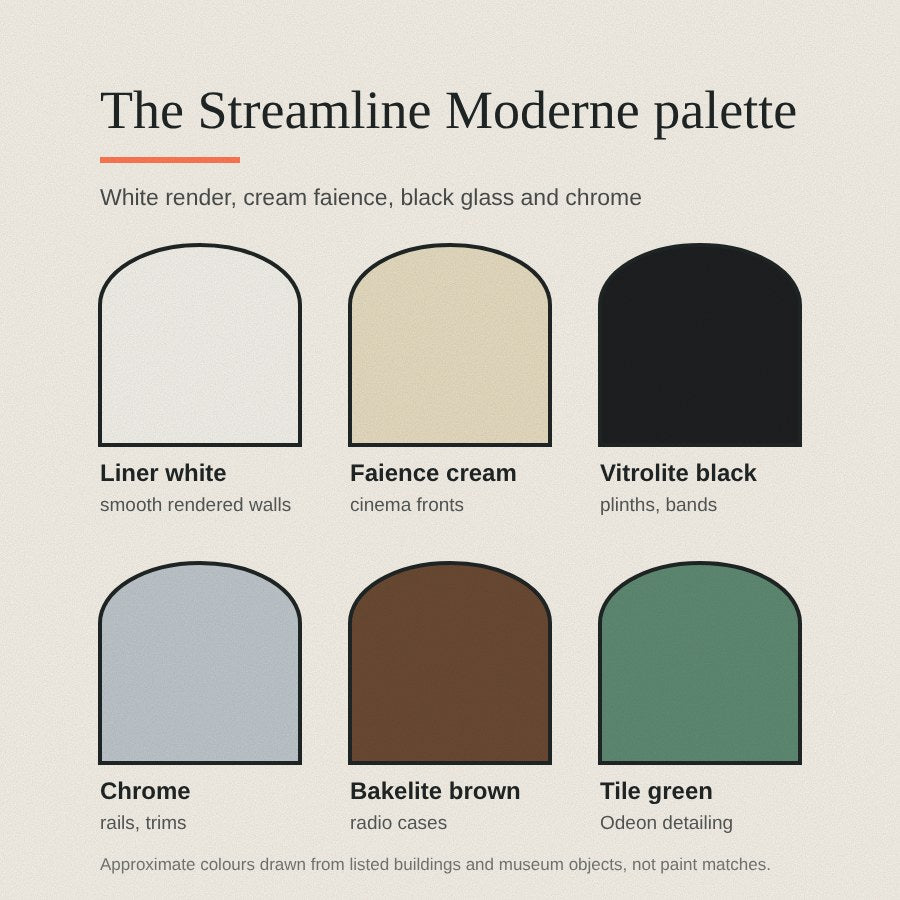
Start with white. Designing Buildings notes that the style was mostly white rather than colourful, and Historic England describes the Midland Hotel as concrete and rendered brick painted white. Odeon fronts added cream: the Kingstanding cinema is dressed in buff and polished black faience, and the Odeon at Weston-super-Mare in cream faience with black glass and green tile details.
Then add machine-age materials. Chrome-plated metal, aluminium and Bakelite were the stuff of American streamlined design, and the V&A’s Ekco AD-65 radio of 1932, designed by Wells Coates, came in a brown Bakelite that imitated burr walnut and outsold the black version. Use those darker notes sparingly, as trims, bands and single objects, against plenty of pale wall.
Signature motifs, shapes and materials
The curve. Rounded corners, curved end walls, bowed bays and cylindrical stair towers are the core of the style. Where Art Deco stepped, Streamline Moderne swept.
Speed lines. Two or three parallel lines running horizontally, in render, faience, metal or paint. Historic England describes the Kingstanding Odeon’s horizontal faience banding stopping round its curved returns.
The ocean liner. Pipe railings on parapets and balconies, porthole windows and flat roofs gave buildings a nautical effect. Liners themselves were national showcases, and the V&A calls the Queen Mary and the Normandie “floating Art Deco palaces”.
Glass and light. Glass block for soft light, long ribbon windows that wrap a corner, and lighting hidden in coves. Odeon interiors were deliberately simple, relying on mouldings and coved lighting rather than ornament.
The details that define a Streamline Moderne room
- Ceiling. Smooth and plain, often with a shallow cove or a single round centrepiece rather than a cornice full of ornament.
- Walls. Pale, flat colour, sometimes with a curved corner or a band of two or three horizontal lines at dado or picture-rail height.
- Floors. Smooth and hard-wearing, such as linoleum or polished boards, with a plain or banded rug.
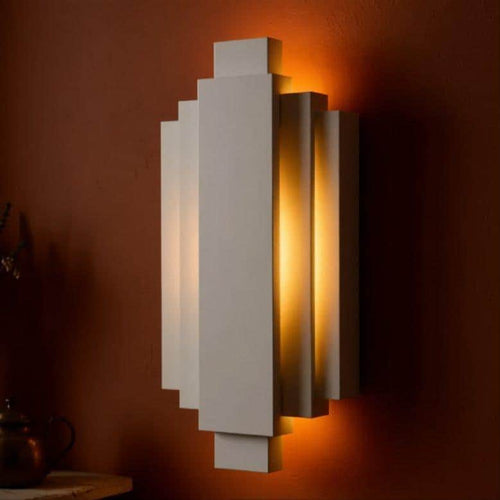
- Lighting. Light washed up the wall or hidden in a cove, rather than a single bright bulb. A rounded or stepped wall light (wall sconce), such as our Half Moon Wall Light, suits it well.
- Metal. Chrome handrails, tubular steel chairs and slim metal trims, used as lines rather than surfaces.
- Furniture. Low pieces with rounded ends, from curved sofas to sideboards with bowed fronts.
- Objects. A round Bakelite radio, a porthole mirror, a streamlined clock or toaster.
Real Streamline Moderne rooms, annotated
Streamline Moderne survives best in public buildings, so here are three British ones and one American. Each photograph is numbered with the features worth noticing. Where we could sample good colour, the swatches come from the photograph itself, so treat them as a guide rather than a paint match.
1. The seaside pavilion staircase
A staircase in the De La Warr Pavilion in Bexhill-on-Sea, looking down the spiral. The pavilion was designed by Erich Mendelsohn and Serge Chermayeff after an open competition, and opened in December 1935. In 1936 a New Statesman correspondent wrote that it felt like being on a great transatlantic liner.

- A thick, polished metal handrail that sweeps round the curve without a break
- Thin rails running parallel below it, like the rails on a ship’s deck
- Slim upright supports fixed to the edge of each flight
- The smooth white underside of the flight above
- The stair winding down round an open well
- A hanging light: a long tube lamp threaded with round discs
- Warm, sand-coloured steps that keep the metal from feeling cold
Colours in this photo:
Polished metal #BFC7D0Sand treads #936C38
Take from it: One continuous curve does all the work. A rounded handrail, a curved wall or a semicircular wall light will carry the idea into an ordinary hallway.
2. The hotel stairwell and its ceiling
Looking straight up the stairwell of the Midland Hotel in Morecambe, built in 1932 to 1933 for the London, Midland and Scottish Railway to designs by Oliver Hill. Historic England describes a cantilevered circular staircase, with a ceiling panel above it carved in low relief by Eric Gill and painted by Denis Tegetmeier.

- The round ceiling panel by Eric Gill, painted by Denis Tegetmeier, full of waves and sea figures
- A lettered border running round the rim, including the words “hear old Triton”
- Plain, smooth ceiling around the panel, so it reads like a ceiling rose (ceiling medallion) on a grand scale
- A balustrade of horizontal bands that follows the curve
- A slim handrail riding on top of the bands
- Each flight winding round the open well
- Plain curved walls with no cornice or moulding
Take from it: A single round motif on a plain ceiling is pure Streamline Moderne. A simple, ringed ceiling rose on a smooth ceiling gives the same effect at home.
3. The Odeon on the high road
The former Odeon at Kingstanding, Birmingham, which opened in July 1935. Historic England credits the design to J Cecil Clavering and Robert Bullivant of Harry Weedon and Partners, and lists the building at Grade II. It closed as a cinema in 1962 and later became a bingo hall.

- A rounded corner bay, one of the gently curved returns in the listing
- Horizontal bands set into the cream faience
- A tower of three faience fins rising above the roofline
- The brick main body behind the faience front
- Polished black faience at the base
- A bowed canopy and sign board over the entrance
- Steps up to the entrance under the canopy
- Columns holding up the canopy
Colours in this photo:
Black faience #090303Brick #3E3026
Take from it: Curves and horizontal lines, in cream against black, made the Odeons instantly recognisable. Keep the same contrast at home: pale walls, one dark band, and one curved shape.
4. The ocean liner on the street corner
The American version, taken to its logical end. The Coca-Cola bottling plant in Los Angeles was designed by Robert V. Derrah in 1939, who wrapped four existing buildings in a single shell shaped like an ocean liner. It became a Los Angeles Historic-Cultural Monument in 1975.

- The ship’s bridge on the flat roof, carrying the Coca-Cola sign
- Double rows of porthole windows
- A rounded corner where the two walls meet
- Thin horizontal lines running along the walls
- Pipe railing on a small balcony
- A flagpole rising above the roof
- A dark base with a red stripe, like a hull at the waterline
Colours in this photo:
Liner white #F3F4F8Coca-Cola red #B63C44Hull black #18151A
Take from it: A porthole is the quickest way to say ocean liner. One round mirror or round window is enough indoors; a whole row is a theme park.
Streamline Moderne to visit in Britain
- De La Warr Pavilion, Bexhill-on-Sea. Mendelsohn and Chermayeff's building opened in 1935 and is Grade I listed. It was named after the 9th Earl De La Warr, who was the driving force behind it, and conceived as a democratic space for art, culture and recreation. The pavilion offers free access to its exhibitions all year, with tickets sold for auditorium events.
- Midland Hotel, Morecambe. Oliver Hill's design of 1932 to 1933 has a convex front facing Morecambe Bay, a flat roof and rounded corners. Eric Gill's two seahorses sit at the top of the central entrance bay, and Marion Dorn designed rugs for the interior. It is listed Grade II*.
- Hoover Building, Perivale. Strictly Art Deco rather than Moderne, but its long, symmetrical front, 15 bays wide with large areas of glazing, shows the same love of the horizontal. Built in 1932 to 1935 and listed Grade II*.
The pavilion made this six-minute documentary itself, for its 80th anniversary. It is a good way to see the building as a whole before you pick out details.
Video: De La Warr Pavilion, "De La Warr Pavilion's 80th Anniversary Documentary", via YouTube.
How to get the Streamline Moderne look
- Round one corner. A curved sofa, a bowed sideboard or a rounded mirror softens a square room straight away. It works in any living room.
- Paint speed lines. Three thin horizontal stripes along a hallway or landing wall, in a darker shade of the wall colour or in black, give movement without clutter. Halls and stairs suit them best because you walk past them.
- Light the walls, not the room. Use wall lights that throw light up and down the wall, and keep the ceiling light soft. Our history of the wall sconce has more on how wall lights developed. Mount them on a landing or either side of a bed.
- Keep the ceiling clean. A plain ceiling with one round, ringed ceiling rose, such as the Ring Ceiling Rose, recalls the Midland Hotel’s single round panel. Paint it the ceiling colour, or pick out one ring. See how to paint a plaster ceiling rose, and our fitting guide before you put one up.
- Add one porthole. A round mirror in a bathroom or hallway is the easiest liner reference there is.
- Use metal as a line. A chrome rail on a towel stand, a slim metal shelf edge or a tubular chair, not a wall of shiny surfaces. Kitchens and bathrooms take this best.
Common mistakes to avoid
- Too many zigzags. Sunbursts and stepped skyscraper shapes belong to earlier Art Deco. Streamline Moderne is calmer and rounder.
- A nautical theme. Anchors, rope and stripes turn it into a seaside café. The style borrowed the shapes of ships, not the souvenirs.
- Chrome everywhere. Too much shine looks cold and cheap. Use metal for rails, trims and handles only.
- Heavy ornament overhead. A deep Victorian rose with leaves and scrolls fights with smooth walls. Choose rings or plain curves.
- Removing original features. If you live in a 1930s house, keep curved bay windows, original glazing and tiled fireplaces. They are the real thing.
Shop the look
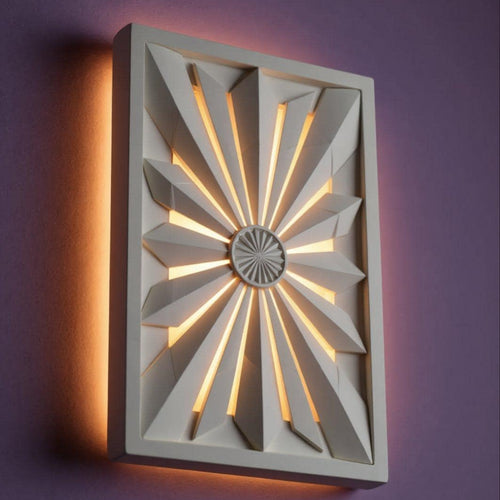
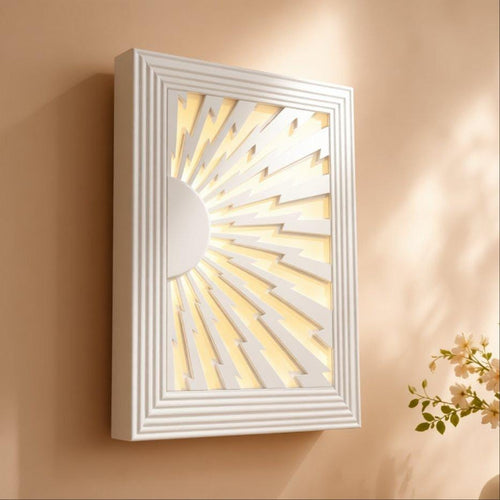
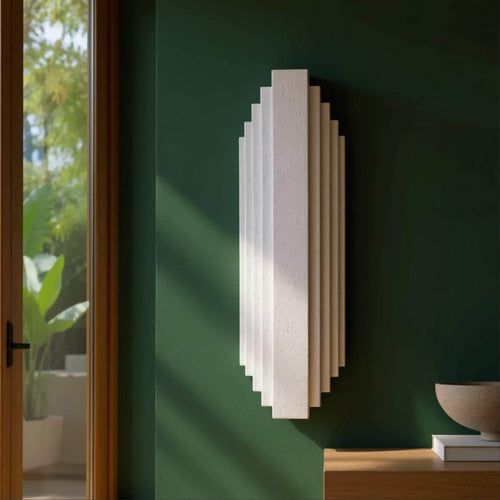
Layered wall lights and plain, ringed ceiling roses for a smooth, curved room.
 Streamline Moderne Wall Light (14.5 in)
 Streamline Moderne Wall Light (12 × 6 in)
 Ring Ceiling Rose
 Vogue Ceiling Rose
Streamline Moderne ceiling roses, wall lights and plaster details
For walls, our Streamline Moderne Wall Light (14.5 in) and Streamline Moderne Wall Light (12 × 6 in) bring the style’s layered lines to a hallway, landing or bedroom. Overhead, the Ring Ceiling Rose and the smaller Vogue Ceiling Rose keep to plain, geometric forms that sit happily on a smooth ceiling.
Every piece in our Art Deco collection is designed and hand-cast in Shrewsbury, and arrives as natural plaster ready to leave raw or paint to suit your room.
Good to know
Common questions
What is the difference between Art Deco and Streamline Moderne?
Streamline Moderne is the later, simpler form of Art Deco from the 1930s. Art Deco favours zigzags, sunbursts and tall vertical lines; Streamline Moderne uses rounded corners, long horizontal lines, mostly white surfaces and very little ornament.
Where can I see Streamline Moderne in Britain?
The De La Warr Pavilion in Bexhill-on-Sea and the Midland Hotel in Morecambe are two of the best examples, and many 1930s Odeon cinemas, such as the former Odeon at Kingstanding in Birmingham, still show the style on the high street.
What ceiling rose suits a Streamline Moderne room?
Choose a plain, geometric rose built from rings or smooth curves, on an otherwise plain ceiling. Paint it the ceiling colour, or pick out a single ring, and avoid deep leafy Victorian designs.
Sources
References and further reading
Harvard style. Web pages were checked on the access date shown.
- Bard Graduate Center (2006) American Streamlined Design: The World of Tomorrow. Available at: www.bgc.bard.edu/exhibitions/exhibitions/36/american-stre... (Accessed: 12 October 2026).
- Bard Graduate Center (n.d.) 'Norman Bel Geddes: I Have Seen the Future', West 86th. Available at: west86th.bgc.bard.edu/exhibitionreviews/norman-bel-geddes... (Accessed: 12 October 2026).
- Bexhill Museum (n.d.) Bexhill entertainment. Available at: bexhillmuseum.org.uk/?p=27 (Accessed: 12 October 2026).
- British Listed Buildings (n.d.) Odeon Cinema, Weston-super-Mare. Historic England list entry 1311970. Available at: britishlistedbuildings.co.uk/101311970-weston-super-mare-... (Accessed: 12 October 2026).
- British Listed Buildings (n.d.) The De La Warr Pavilion, Bexhill-on-Sea. Historic England list entry 1352840. Available at: britishlistedbuildings.co.uk/101352840-the-de-la-warr-pav... (Accessed: 12 October 2026).
- British Listed Buildings (n.d.) Top Rank Club (former Odeon Cinema), Kingstanding. Historic England list entry 1076275. Available at: britishlistedbuildings.co.uk/101076275-top-rank-club-ward (Accessed: 12 October 2026).
- Cinema Treasures (n.d.) Odeon Kingstanding. Available at: cinematreasures.org/theaters/22733 (Accessed: 12 October 2026).
- Dawson, D. (2007) De La Warr Pavilion staircase [Photograph]. Wikimedia Commons. CC BY 2.0. Available at: commons.wikimedia.org/wiki/File:De_La_Warr_Pavilion_stair... (Accessed: 12 October 2026).
- Designing Buildings (n.d.) Streamline Moderne. Available at: www.designingbuildings.co.uk/wiki/Streamline_Moderne (Accessed: 12 October 2026).
- Discover Bexhill (2015) De La Warr Pavilion 80th anniversary. Available at: www.discoverbexhill.com/articles/de-la-warr-pavilion-80-a... (Accessed: 12 October 2026).
- Docomomo US (n.d.) Streamline Moderne. Available at: www.docomomo-us.org/style/steamline-moderne (Accessed: 12 October 2026).
- English Heritage (n.d.) History of Eltham Palace. Available at: www.english-heritage.org.uk/visit/places/eltham-palace-an... (Accessed: 12 October 2026).
- Grace's Guide to British Industrial History (n.d.) Mallard. Available at: www.gracesguide.co.uk/Mallard (Accessed: 12 October 2026).
- Highsmith, C.M. (2005) Coca-Cola Building Los Angeles [Photograph]. Library of Congress, via Wikimedia Commons. Public domain. Available at: commons.wikimedia.org/wiki/File:Coca-Cola_Building_Los_An... (Accessed: 12 October 2026).
- Hisgett, T. (2010) Odeon Cinema Kingstanding [Photograph]. Wikimedia Commons. CC BY 2.0. Available at: commons.wikimedia.org/wiki/File:Odeon_Cinema_Kingstanding... (Accessed: 12 October 2026).
- Historic England (n.d.) Midland Hotel, Morecambe. List entry 1208988. Available at: historicengland.org.uk/listing/the-list/list-entry/1208988 (Accessed: 12 October 2026).
- Jhsteel (2008) Midland Hotel staircase [Photograph]. Wikimedia Commons. CC BY-SA 3.0. Available at: commons.wikimedia.org/wiki/File:Midland_Hotel_staircase.jpg (Accessed: 12 October 2026).
- Modernist Britain (n.d.) Midland Hotel, Morecambe. Available at: www.modernistbritain.co.uk/post/building/Midland+Hotel+Mo... (Accessed: 12 October 2026).
- RIBApix (n.d.) Midland Hotel, Morecambe, Lancashire, looking up the main staircase to the ceiling panel by Eric Gill. Available at: www.architecture.com/image-library/RIBApix/licensed-image... (Accessed: 12 October 2026).
- SAH Archipedia (n.d.) Coca-Cola Bottling Plant, Los Angeles. Available at: archipediavm.upress.virginia.edu/buildings/CA-01-037-0010 (Accessed: 12 October 2026).
- The Twentieth Century Society (n.d.) 1935: De La Warr Pavilion, Bexhill-on-Sea. Available at: c20society.org.uk/100-buildings/1935-de-la-warr-pavilion-... (Accessed: 12 October 2026).
- Theatres Trust (n.d.) De La Warr Pavilion. Available at: database.theatrestrust.org.uk/resources/theatres/show/27 (Accessed: 12 October 2026).
- Victoria and Albert Museum (2018) About the Ocean Liners: Speed & Style exhibition. Available at: www.vam.ac.uk/articles/about-the-ocean-liners-speed-style... (Accessed: 12 October 2026).
- Victoria and Albert Museum (n.d.) Ekco AD-65 radio, Wells Coates. Available at: collections.vam.ac.uk/item/O22790/ekco-ad-65-radio-coates... (Accessed: 12 October 2026).
- De La Warr Pavilion (n.d.) Who we are. Available at: www.dlwp.com/about-us/ (Accessed: 13 October 2026).
- Historic England (n.d.) Main Front Block to Hoover Factory, List Entry 1079353. Available at: historicengland.org.uk/listing/the-list/list-entry/1079353 (Accessed: 13 October 2026).
- Twentieth Century Society (n.d.) The Midland Hotel, Morecambe. Available at: c20society.org.uk/botm/the-midland-hotel-morecambe/ (Accessed: 13 October 2026).
How to cite this article
van Locke, J. (2026) ‘Streamline Moderne: curves, speed lines and the ocean-liner look’, The Flare Journal. Flare Studio UK. Available at: https://flarestudio.uk/blogs/journal/streamline-moderne-guide (Accessed: 17 October 2026).
Shop the style